Research Insight
Health Status and Environmental Adaptability of Spotted Sea Bass Under Different Salinity Conditions 

 Author Correspondence author
International Journal of Marine Science, 2026, Vol. 16, No. 5
Received: 25 Aug., 2026 Accepted: 29 Sep., 2026 Published: 30 Oct., 2026
Salinity is a critical environmental factor affecting the physiological homeostasis, growth performance, immune function, and overall health of sea bass in aquaculture systems. This review comprehensively examines the responses and adaptive mechanisms of sea bass under different salinity conditions, with particular emphasis on the interactions among environmental conditions, growth performance, physiological regulation, immune responses, and molecular adaptation. The effects of salinity on feed intake, growth, survival, and physiological condition are first summarized, followed by an analysis of osmoregulatory mechanisms involving the gills, intestine, endocrine system, and energy allocation. The responses of oxidative stress, innate immunity, and disease resistance to salinity variation are further discussed. In addition, molecular mechanisms associated with ion transport, osmoregulation, antioxidant defense, stress responses, and metabolism are evaluated. A case study is presented to compare the growth, health status, and environmental adaptability of sea bass under low, optimal, and high salinity conditions. Finally, practical salinity management and acclimation strategies, current research gaps, and future research directions are discussed. This review provides a comprehensive framework for evaluating salinity adaptability and supports more precise and sustainable salinity management in sea bass aquaculture.
1 Introduction
Salinity is one of the most important abiotic factors shaping the survival, growth, reproduction, metabolism, and physiological homeostasis of aquatic animals, and its fluctuations have become a central issue in modern aquaculture (Wang et al., 2023). In culture systems, salinity does not simply determine whether fish survive; it also regulates osmotic balance, ion transport, endocrine responses, antioxidant defense, tissue integrity, and ultimately production efficiency. Rapid or chronic salinity shifts can arise from tidal exchange, rainfall, drought, evaporation, saline intrusion, and broader climate-driven hydrological change, so cultured fish are increasingly exposed to unstable osmotic environments rather than fixed conditions. This issue is especially relevant as freshwater resources become more limited and saline or saline-alkaline waters are increasingly viewed as alternative aquaculture resources (Saleh et al., 2026). Across fish species, inappropriate salinity commonly reduces growth, feed efficiency, and physiological performance, whereas species-specific intermediate salinities can lower osmoregulatory cost and improve culture outcomes. For example, high salinity reduced growth and antioxidant capacity in juvenile Eleutheronema tetradactylum, while lower salinities around 5-10 PSU supported better performance. In black sea bream, a salinity near 15 psu minimized oxidative stress indicators and improved feed conversion, suggesting that suitable salinity can directly enhance farming benefits. Similar patterns have been reported in other cultured fishes: excessive salinity can elevate cortisol, osmolality, ion imbalance, and mortality, while moderate salinity may permit adaptive adjustment without overt tissue injury. Mechanistically, salinity stress activates conserved cellular programs involving osmosensing, energy reallocation, macromolecular protection, and, under severe challenge, apoptosis, indicating that salinity adaptation is a whole-organism process rather than a single osmoregulatory event (Evans and Kültz, 2020). Metabolomic and transcriptomic evidence further shows that salinity acclimation depends on coordinated shifts in energy metabolism, amino acid turnover, ion transport, immune signaling, and oxidative balance. The gill structures and serum osmolality changes under graded salinity in juvenile fish visually show how osmoregulatory tissues respond to salinity challenge over time.
Against this background, spotted sea bass (Lateolabrax maculatus) is a particularly important species for studying salinity adaptation because it combines high aquaculture value with strong euryhalinity. This species is widely distributed in coastal and estuarine regions of China, Japan, and the Korean Peninsula, where salinity conditions can vary substantially across habitats and seasons. Spotted sea bass can adapt from freshwater to seawater, and previous work indicates that it survives over a broad salinity range while exhibiting species-specific optima for growth and physiological stability (Zhu et al., 2023). Long-term acclimation experiments show that juvenile spotted sea bass maintain comparable growth at 0, 12, and 30 ppt, but growth is significantly inhibited at 45 ppt, demonstrating broad tolerance with clear upper-stress limits. At the physiological level, this euryhaline capacity depends on dynamic regulation of ion transport, especially in classical osmoregulatory organs such as gill, kidney, and intestine. In spotted sea bass, Na+/K+-ATPase activity is highest in gill tissue and varies with salinity, while several nka isoforms are highly expressed in osmoregulatory organs and transcriptionally regulated by altered salinity. Gill transcriptomic analyses further indicate that salinity change triggers coordinated cellular responses linked to oxidative stress, osmoregulation, signal transduction, and antioxidative activity. Integrated miRNA-mRNA analyses add that salinity acclimation in the gill is associated with glucose metabolism, vascular maintenance, and hematopoiesis-related regulation, highlighting the complexity of local adaptation processes. Liver transcriptomics similarly shows that salinity-responsive genes in spotted sea bass are enriched in ion transport, energy metabolism, immune response, signal transduction, and structural reorganization, indicating that acclimation is systemic rather than confined to one tissue. Recent physiological and transcriptomic work also suggests that moderate salinity elevation can improve protein utilization, whereas broader salinity stress alters digestive enzyme activity, oxidative status, and genes involved in metabolism, immunity, and osmoregulation (Hu et al., 2024). The salinity-dependent differences in gill morphology and blood and mucous cell abundance in spotted sea bass directly illustrate that acclimation has measurable structural as well as molecular correlates.
These characteristics make it necessary to investigate the health status and environmental adaptability of spotted sea bass under different salinity conditions in an integrated way. Although spotted sea bass is widely recognized as euryhaline, tolerance alone does not mean all salinity conditions are equally suitable for health, welfare, or commercial production. Studies in multiple fishes show that fish can survive salinity transfer while still experiencing gill injury, oxidative imbalance, metabolic disturbance, immune disruption, and transient apoptosis, all of which can reduce long-term performance. In black seabream, acute low salinity induced oxidative stress and endoplasmic reticulum stress before physiological adaptation became evident over time. In red tilapia, salinity stress caused gill structural damage, altered Na+/K+-ATPase and antioxidant responses, disrupted ion balance, and later produced oxidative imbalance and immune activation. Similar salinity-linked increases in lipid peroxidation, inflammatory cytokines, cortisol, and tissue dysfunction have also been documented in other aquatic species, reinforcing that health assessment must extend beyond simple survival or growth endpoints. For spotted sea bass specifically, current evidence has established broad salinity adaptability and identified molecular pathways related to osmoregulation, but relatively fewer studies have integrated health indicators such as serum biochemistry, antioxidant status, tissue condition, and environmental adaptability across different salinity regimes within a single framework. This gap is important because practical aquaculture requires not only identifying whether spotted sea bass can withstand freshwater, brackish water, or seawater, but also determining which salinity ranges best support internal homeostasis, organ function, stress resistance, and adaptive stability. Such knowledge would improve salinity management in coastal and inland culture systems, support the evaluation of culture suitability under changing environmental conditions, and provide physiological and molecular evidence for breeding and farming strategies aimed at more resilient production of spotted sea bass. Accordingly, examining the health status and environmental adaptability of spotted sea bass under different salinity conditions is both scientifically necessary and practically relevant for understanding its salinity-response mechanisms and optimizing sustainable aquaculture.
2 Salinity Characteristics and Ecological Significance in Sea Bass Aquaculture Environments
2.1 Natural habitats and salinity variation characteristics of sea bass
Spotted sea bass (Lateolabrax maculatus) is a euryhaline coastal fish widely distributed in the estuarine and nearshore waters of China, Japan, and the Korean Peninsula, where salinity is naturally heterogeneous across space and time. Its ecological niche is closely linked to brackish-water environments because juveniles commonly occupy estuarine areas, while the species can also enter freshwater and later use higher-salinity waters during maturation, indicating a life history tied to salinity transitions rather than a single fixed habitat. This habitat use pattern is consistent with the general biology of euryhaline sea basses, which often move among coastal waters, lagoons, estuaries, and riverine zones as environmental conditions change (Ordóñez-Grande et al., 2021). In spotted sea bass specifically, prior studies indicate survival across a very broad salinity range, from freshwater to seawater, with an apparent growth optimum around 16-17 ppt, suggesting that broad tolerance and optimal performance are not the same ecological property.
The salinity regime experienced by spotted sea bass in nature is highly dynamic because tides, terrestrial runoff, seasonal precipitation, and climate-related hydrological change can rapidly alter estuarine osmotic conditions. More generally, salinity is a key determinant of fish distribution and niche occupancy, and future environmental change is expected to reshape the suitable habitat of Lateolabrax species, with projected contraction and marked poleward shift for L. maculatus under warming scenarios. Evidence from euryhaline sea bass relatives also shows that populations can diverge in habitat use, with some individuals remaining in coastal habitats while others show persistent freshwater-associated life histories, underscoring the ecological plasticity that often accompanies salinity tolerance (Almeida et al., 2026). Together, these patterns indicate that salinity variation is not merely a background condition in sea bass ecology, but a structuring force that shapes migration, habitat selection, growth opportunity, and ultimately the environmental adaptability of the species.
2.2 Salinity conditions under different aquaculture systems
The broad salinity adaptability of spotted sea bass gives this species unusual flexibility in aquaculture, making production feasible in both freshwater ponds and seawater cages, and more recently relevant to saline-alkaline water development. This flexibility is economically important because different culture systems expose fish to very different salinity regimes: coastal cages generally operate in seawater or high-brackish conditions, inland ponds may rely on freshwater domestication, and industrial systems can deliberately manipulate salinity to improve system performance or reduce costs. In sea bass farming more broadly, cage-site recommendations often place suitable salinity in a moderate-to-high brackish or marine range, while coastal pond systems may experience strong seasonal shifts that still support profitable production. These differences mean that salinity management in aquaculture is system-specific, and the “appropriate” salinity depends not only on species tolerance but also on engineering constraints, water source, production stage, and management objective (Seale et al., 2024).
Evidence from experimental and commercial culture systems shows that sea bass can maintain acceptable performance over a substantial salinity gradient, but only within biologically defined limits. In juvenile spotted sea bass, long-term acclimation showed no significant growth difference among 0, 12, and 30 ppt, whereas growth was significantly inhibited at 45 ppt, indicating that hypertonic conditions impose a clear physiological cost despite the species’ euryhalinity. Comparable system-level findings in other sea bass aquaculture support this interpretation: black sea bass reared in low-salinity recirculating systems at about 10.1-12.3 g/L maintained long-term growth, while more extreme low salinity reduced survival unless dietary salt was supplemented. In brackish aquaponic systems, European sea bass performed better at 8-14 ppt than at 20 ppt, and nutrient-removal efficiency of the coupled plant component also improved at the lower salinities, showing that optimal salinity in integrated systems reflects both fish physiology and whole-system function (Vlahos et al., 2023). A system-level comparison in freshwater Asian sea bass culture further showed that dissolved oxygen management interacts with salinity strategy, as freshwater recirculating systems achieved higher yields than biofloc ponds when aeration was effectively controlled (Figure 1).
|
Figure 1 Conceptual framework illustrating salinity gradients, major sea bass aquaculture systems, and corresponding physiological and production responses. The figure emphasizes that salinity tolerance does not necessarily correspond to the optimal salinity for growth or system-level production performance |

2.3 Interactions between salinity and other environmental factors
Salinity does not act in isolation in aquaculture environments; rather, its biological significance emerges through interaction with temperature, dissolved oxygen, pH, alkalinity, feeding, and other physicochemical variables that jointly determine fish welfare and production performance (Mariu et al., 2023). In recirculating systems, salinity is one of several core operating variables that must be controlled within suitable ranges, and its effects can be amplified or moderated by temperature, oxygen availability, stocking density, and feeding regime. At the organismal level, these interactions matter because salinity challenge alters osmoregulatory demand, and any simultaneous deterioration in oxygen supply or acid-base conditions can further shift energy allocation away from growth and toward maintenance. This is especially important for sea bass aquaculture because the species is often reared in highly variable estuarine, coastal, or intensive land-based systems where multiple environmental drivers fluctuate together rather than independently.
Available evidence shows that combined stressors often produce stronger biological effects than salinity alone. Climate-driven warming can simultaneously increase evaporation, elevate salinity, and reduce dissolved oxygen, a combination that has been shown in fish to depress growth, impair feed utilization, disrupt immunity, and aggravate tissue damage under hypoxic and saline conditions (Monier et al., 2025). In spotted sea bass, salinity change is also closely linked with alkalinity stress and cellular oxidative responses: gill transcriptomic analyses showed that salinity transfer induced osmotic and antioxidative adjustment, whereas alkaline water caused broader disruption of immune and antioxidative functions, indicating that water chemistry interactions can qualitatively change the adaptive response. Salinity can also influence reproduction-related physiology, since freshwater acclimation in maturing male spotted sea bass increased cortisol and 11-ketotestosterone and was associated with partial testicular degradation, suggesting that altered osmotic environments may reshape endocrine status as well as somatic condition. Therefore, evaluating environmental adaptability under different salinity conditions requires a multi-factor perspective in which salinity is treated as a central but interacting driver of health status, rather than as a single independent variable.
3 Growth and Production Performance of Sea Bass under Different Salinity Conditions
3.1 Effects of salinity on feed intake, feed utilization, and growth performance
Salinity strongly influences feed intake, feed utilization, and growth performance in sea bass, but the relationship is typically non-linear rather than monotonic. In spotted sea bass, moderate salinity can support better nutrient use, as 24 psu improved protein utilization efficiency while salinity stress inhibited intestinal lipase activity, indicating that digestive performance changes before gross growth failure becomes evident. Over longer culture periods, juvenile spotted sea bass reared at 20‰ showed a trend toward higher weight gain and specific growth rate and a lower feed conversion ratio than fish reared in freshwater, suggesting that moderate brackish conditions can improve production efficiency even when the effect size is modest. More broadly, controlled aquaculture studies across fishes show that euryhaline species often grow best at intermediate salinities , where osmoregulatory costs are reduced and more energy can be allocated to somatic growth.
This pattern is consistent across other sea bass taxa and culture settings. In Asian seabass juveniles, 22 ppt produced the highest weight gain, daily growth, specific growth rate, and the lowest feed conversion ratio, identifying an intermediate salinity window as optimal for juvenile production (Hassan et al., 2022). European sea bass juveniles reared at 15‰ also showed significantly improved growth and feed utilization relative to 10‰, reinforcing that moderate brackish salinity can enhance feeding efficiency in sea bass culture. By contrast, performance declines at salinity extremes are often linked to reduced appetite and increased osmoregulatory demand, and hyper-saline conditions can suppress feeding and growth despite survival being maintained. The reported growth responses across salinity treatments are summarized clearly by the polynomial and treatment comparisons showing an optimum near 20-22 ppt in juvenile seabass culture.
3.2 Survival and physiological condition
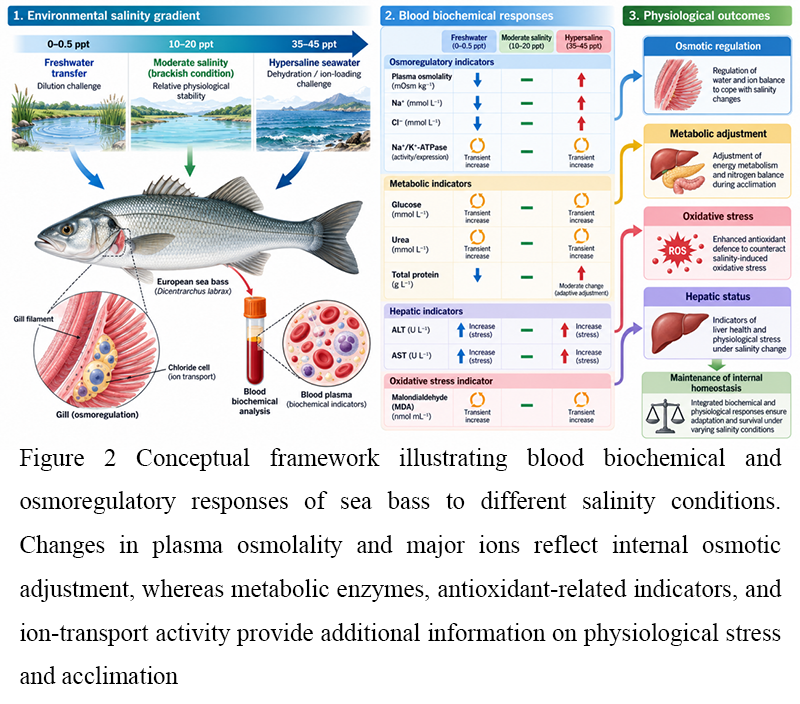
Survival of spotted sea bass remains relatively robust across a wide salinity range, but physiological condition deteriorates before mortality necessarily increases. In juvenile Lateolabrax maculatus, 30 days of acclimation caused significant growth inhibition at 45 ppt, and hypertonic exposure also increased plasma osmolality, Na+, Cl−, glucose, urea, total protein, and ALT and AST activities, indicating substantial osmotic and metabolic strain even in surviving fish. Acute low-salinity transfer in juvenile Chinese sea bass caused no mortality and behavior normalized rapidly, yet liver cells still showed swelling, vacuolation, and nuclear pyknosis, with stronger responses at lower salinity, which shows that short-term tolerance does not imply absence of tissue stress.
The physiological signature of salinity stress in sea bass includes shifts in antioxidant defense, ion regulation, endocrine stress, and tissue remodeling. In spotted sea bass exposed to different salinity gradients, Na+/K+-ATPase and malondialdehyde both rose and then fell, peaking at 72 h, consistent with an acute compensatory response followed by adjustment or exhaustion depending on severity. Gill transcriptomics further indicates that salinity transfer mainly triggers oxidative and osmotic stress pathways, whereas alkalinity imposes a broader and more damaging suppression of immune and antioxidative functions, suggesting that salinity alone is stressful but often more manageable than combined saline-alkaline challenge. Evidence from other bass species supports the same interpretation: mortality rose sharply in largemouth bass as salinity increased, and 12 ppt caused gill and intestinal injury, while European sea bass under extreme hypo- and hypersaline exposure showed increased mucus loss and energetic cost, especially at 50‰ (Ordóñez-Grande et al., 2021).
3.3 Growth stage differences
Salinity responses differ substantially among growth stages, and early ontogeny is often the most sensitive period. In sea bass, salinity tolerance and osmoregulatory capacity are age- and size-dependent , not fixed properties established at hatching. Work on European sea bass showed that all developmental stages hyper-regulate at low salinity and hypo-regulate at higher salinity, but full hypo-regulatory capacity is acquired stepwise during development and reaches a maximum in juveniles about 17-26 mm in length at 63-86 days after hatching. This developmental progression helps explain why the ecological transition of young sea bass into estuarine and brackish habitats becomes increasingly feasible as the osmoregulatory machinery matures.
Stage specificity also appears within cultured sea bass and comparable fishes. Juvenile spotted sea bass tolerate large salinity shifts, but both acute low-salinity exposure and long-term hypertonic acclimation still alter liver structure, serum biochemistry, and energy-metabolism pathways, indicating that the juvenile stage is adaptable yet metabolically expensive under stress. In maturing male spotted sea bass, freshwater acclimation significantly increased cortisol and 11-ketotestosterone and was accompanied by partial testicular degradation, showing that salinity reduction can also disrupt reproductive-stage physiology rather than only juvenile growth. Comparable evidence from early ontogeny in largemouth bass further shows that eggs, embryos, and yolk-sac larvae lose survival capacity rapidly as salinity rises, with a particularly sharp decline between 10 and 20 ppt, underscoring that salinity windows suitable for juveniles or adults cannot be assumed to be safe for earlier stages (Luo and Yang, 2023).
4 Physiological and Osmoregulatory Mechanisms of Sea Bass under Different Salinity Conditions
4.1 Gill- and intestine-mediated ion and osmotic regulation
The gill is the primary interface through which sea bass adjusts ion fluxes during salinity change, while the intestine provides complementary transport functions that become more important during sustained acclimation. In spotted sea bass, Na+/K+ATPase activity is highest in the gill and changes with salinity, reaching its greatest activity under 45 ppt exposure, which indicates that branchial ion pumping is intensified as osmotic demand increases (Zhang et al., 2019). Several nka isoforms are also selectively enriched in osmoregulatory tissues, and the gill-specific patterns of nkaα1a and nkaβ1b closely track total NKA activity, supporting their central role in primary ion transport during salinity adaptation. Gill transcriptomic data further show that freshwater acclimation regulates multiple solute carrier genes and other osmotic-stress-responsive pathways, indicating that branchial adjustment involves coordinated transporter remodeling rather than a single-enzyme response. This salinity-sensitive branchial plasticity is a general sea bass trait, because European sea bass transferred from 15 ppt to either freshwater or 50 ppt doubled gill NKA activity after transfer, and that increase was preceded by a 2- to 5-fold rise in gill NKA α-subunit mRNA.
The intestine participates in osmotic compensation, but available evidence suggests that its contribution is typically secondary to that of the gill in acute salinity responses. In freshwater-to-brackish tolerant bass, salinity stress increases NKCC1a expression in both gill and intestine, yet the gill expresses this transporter at two- to fourfold higher levels than the intestine, indicating branchial prioritization of ion transport under challenge. In spotted sea bass, intestinal regulation is still clearly salinity-sensitive, since nkaβ2a expression in the intestine changes significantly across 0, 12, 30, and 45 ppt treatments, showing that gut ion transport machinery is transcriptionally recruited during acclimation. Comparative work in black sea bream shows that intestinal NKA activity can increase under low-salinity stress, but its stabilization pattern differs from that of gill and kidney, which supports organ-specific timing in osmotic adjustment (Yuan et al., 2026). Gill structure also shifts with salinity, with salinity-dependent changes in ionocyte abundance and morphology in Asian sea bass and the appearance of freshwater-associated lamellar ionocytes under hypoosmotic conditions, illustrating that epithelial remodeling accompanies transporter regulation.
4.2 Endocrine regulation and energy allocation
Endocrine regulation links salinity perception to growth, osmoregulation, and energy partitioning, but the balance among hormones depends on both salinity level and exposure duration. In black sea bream, growth hormone and cortisol behaved as seawater-acclimating hormones, whereas prolactin functioned as a freshwater-acclimating hormone, consistent with the classic endocrine split between salt secretion and ion uptake strategies. In juvenile largemouth bass, however, serum prolactin and cortisol did not differ significantly among 0 to 10 ppt groups, while triiodothyronine declined across all salinity treatments and thyroxine decreased significantly at 8 to 9 ppt, suggesting that thyroid-related pathways can shift even when some stress hormones remain comparatively stable. In Asian sea bass, serum cortisol and glucose increased with salinity up to 35‰ and then fell at 50‰, implying that moderate-to-high salinity elevates endocrine stress signaling, whereas more extreme exposure may reflect impaired or exhausted compensation (Azodi et al., 2021). In Chinese sea bass, the HPS axis is closely co-expressed with feeding, metabolism, and growth functions under environmental stress, supporting the view that endocrine regulation coordinates food intake and energetic allocation rather than controlling osmoregulation in isolation.
Salinity acclimation is energetically expensive, and much of the adaptive response reflects reallocation of metabolic resources toward ion homeostasis. In spotted sea bass, liver transcriptomics identifies carbohydrate metabolism and related energy pathways as central to salinity adaptation, consistent with the liver supplying glucose and other metabolites to gill and other osmoregulatory organs under stress. Long-term acclimation experiments in juvenile spotted sea bass further show that hypertonic conditions activate energy metabolism pathways, whereas hypotonic acclimation preferentially promotes signal transduction, indicating that different osmotic directions impose distinct energetic demands. Sustained salinity challenge in European sea bass similarly increases energy expenditure and depletes carbohydrate reserves, with the hyperosmotic 50‰ condition demanding more energy than extreme hypoosmotic exposure. Nutritional status also modifies this balance, because fed sea bass acclimated to reduced salinity maintain plasma ion-osmotic homeostasis more effectively than fasted fish and show stronger NKA upregulation, indicating that adequate energy supply directly supports compensatory osmoregulation.
4.3 Blood biochemical and osmoregulatory parameters
Blood biochemical indices respond rapidly to salinity challenge and provide a practical readout of internal osmotic disturbance. In juvenile spotted sea bass, long-term hypertonic acclimation significantly increases plasma osmolality as well as serum Na+, Cl-, glucose, urea, total protein, and ALT and AST activities, showing that elevated salinity alters both ion balance and broader metabolic and hepatic status. In spotted seabass exposed to salinity gradients, Na+/K+-ATPase and malondialdehyde both rose and then declined, peaking at 72 h, which indicates an early activation of osmoregulatory and oxidative-stress responses during adjustment. Parallel evidence from European sea bass shows that transfer to freshwater decreases plasma osmolality, Na+, and Cl-, whereas transfer to hypersaline seawater increases them, confirming that the direction of salinity change determines the direction of blood ionic displacement. The associated shifts in osmolality and major ions are clearly visualized across freshwater and seawater acclimation conditions.
These blood responses are modulated by both environmental context and physiological state rather than reflecting salinity alone. In European sea bass, low salinity combined with feed deprivation severely alters plasma osmolality, Na+, and Cl-, whereas fed fish avoid much of that osmotic perturbation, indicating that nutritional condition buffers blood-level instability. Under high environmental ammonia, fed fish at 10 to 2.5 ppt maintain plasma osmolality and major ion concentrations better than fasted fish, again showing that salinity tolerance depends partly on metabolic support for ion regulation. Blood variables also interact with chronic stress history: chronically stressed European sea bass show increased plasma chloride and sodium despite limited changes in osmotic pressure, suggesting that osmoregulatory dysfunction can emerge before gross osmotic collapse (Sadoul et al., 2021). Across sea bass studies, plasma osmolality, major electrolytes, cortisol-related stress signaling, and enzyme activities together provide the clearest picture of how well fish maintain internal stability under different salinity conditions (Figure 2).
|
Figure 2 Conceptual framework illustrating blood biochemical and osmoregulatory responses of sea bass to different salinity conditions. Changes in plasma osmolality and major ions reflect internal osmotic adjustment, whereas metabolic enzymes, antioxidant-related indicators, and ion-transport activity provide additional information on physiological stress and acclimation |
5 Health and Immune Responses of Sea Bass under Different Salinity Conditions
5.1 Salinity stress and oxidative stress
Salinity stress alters redox homeostasis in spotted sea bass before it causes obvious mortality. In spotted seabass exposed to different salinity gradients, malondialdehyde and Na+/K+-ATPase both increased first and then declined, with peaks at 72 h, indicating that osmotic adjustment was accompanied by a transient rise in oxidative stress. In juvenile Chinese sea bass subjected to acute low-salinity transfer, hepatic total antioxidant capacity and superoxide dismutase also rose rapidly and then fell, while malondialdehyde fluctuated strongly before returning toward baseline, showing that antioxidant activation is an early compensatory response rather than a stable condition. The time-course pattern of oxidative stress and recovery in juvenile sea bass liver is shown directly by the antioxidant and lipid peroxidation profiles.
Transcriptomic evidence supports the same interpretation at the cellular level. Gill co-expression analysis in Chinese sea bass showed that salinity change triggered a coordinated response involving oxidative and osmotic stress, but the oxidative disturbance under salinity transfer was more moderate than that seen under alkalinity challenge. More generally, salinity stress in fish induces a conserved cellular stress response centered on macromolecular protection, energy reallocation, and, when stress is severe, programmed cell death, which explains why oxidative disturbance often appears alongside broader physiological costs (Evans and Kültz, 2020). Comparable work in European sea bass also shows that reduced salinity can induce oxidative stress, especially when combined with fasting or other co-stressors, indicating that salinity effects on oxidative balance depend on energetic state as well as osmotic load.
5.2 Effects of salinity on innate immune function
Salinity change affects innate immunity in spotted sea bass, but the direction of the response depends on stress intensity and duration. Under acute low-salinity stress, juvenile Chinese sea bass showed increased hepatic lysozyme activity between 12 and 48 h, while alkaline phosphatase and acid phosphatase rose first and then declined, which suggests a short-term activation of non-specific immune defense during early adjustment. This pattern is consistent with broader evidence that acute, short-term stress can transiently enhance innate immune functions, whereas prolonged stress tends to depress immune competence and increase infection risk.
Longer or more extreme salinity deviations appear less favorable for immune homeostasis. Liver transcriptomics in spotted sea bass identified salinity-responsive immune genes, including complement C1q-like protein 2 and interleukin-8, with complement expression higher under low than high salinity, indicating that salinity level can reshape inflammatory and antimicrobial pathways rather than simply turning immunity up or down. In another euryhaline teleost, both low and high salinity altered splenic immune regulation, but hypersaline conditions activated NOD-like receptor signaling while still reducing functions linked to phagosome activity and antimicrobial defense, showing that immune stimulation can coexist with immune dysfunction (Wan et al., 2024). Similar dissociation has been reported in chronically stressed fish, where elevated salinity increased lysozyme, complement, and respiratory burst yet ultimately interfered with immune homeostasis rather than improving protection.
5.3 Salinity variation and disease resistance
Salinity variation can modify disease resistance even when fish remain alive and behaviorally normal. In grass carp, salinity treatment did not clearly reduce survival in the absence of infection, but it increased the proportion of unhealthy fish and also increased susceptibility to Flavobacterium columnare, showing that sublethal salinity stress can erode host resistance (Fang et al., 2022). A similar pattern appears in euryhaline coastal fish during bacterial challenge: under reduced environmental salinity, cytokine induction was slower and weaker, while lysozyme, complement C3, and IgM remained lower than in seawater-acclimated fish, indicating immunosuppression under hypoosmotic stress.
The consequences of salinity for disease outcome are not uniform, because they reflect both host condition and pathogen biology. Abrupt salinity reduction in grouper depressed cellular and humoral immunity and increased mortality after Vibrio alginolyticus injection, whereas a smaller salinity drop caused immunomodulation rather than the same degree of collapse. In pipefish, salinity change increased immune cell activity in uninfected fish, yet individuals held at low salinity failed to mount full immune responses after Vibrio infection, consistent with an osmoregulation-immunity trade-off . At the pathogen level, low salinity can sometimes reduce mortality by impairing bacterial adhesion even when it does not suppress bacterial growth, which helps explain why salinity-disease relationships are system-specific rather than universally harmful or protective. Overall, the evidence indicates that spotted sea bass has substantial tolerance to salinity fluctuation, but health status under salinity stress depends on whether antioxidant defenses, innate immunity, and pathogen resistance can remain coordinated rather than merely activated.
6 Molecular Mechanisms of Salinity Adaptation and Comprehensive Evaluation in Sea Bass
6.1 Osmoregulatory genes and ion transport pathways
At the molecular level, salinity adaptation in spotted sea bass is centered on coordinated regulation of ion transporters and membrane channels across classical osmoregulatory tissues. Na+/K+-ATPase is the core active transport system in this process, and spotted sea bass possesses multiple nka α- and β-subunit isoforms, several of which are highly expressed in gill, kidney, and intestine, indicating clear tissue specialization for ionic control. Among these, nkaα1a, nkaα3b, nkaβ1b, nkaα3a, and nkaβ2a show salinity-sensitive expression, and the parallel changes of branchial nkaα1a and nkaβ1b with total NKA activity suggest that these isoforms are major drivers of primary ion transport during acclimation. Complementing ATP-dependent transport, gill transcriptomic analyses under freshwater transfer reveal broad regulation of solute carrier genes, showing that salinity adaptation depends on a network of transmembrane transport systems rather than a single pump pathway (Zhu et al., 2023). Liver transcriptomics reaches the same conclusion from a systemic angle, because candidate salinity-responsive genes were enriched in the category of metabolites and ion transporters, linking local ion regulation with whole-body osmotic homeostasis.
Water movement is regulated in parallel with ion transport, and aquaporins appear to be important components of the freshwater acclimation response in spotted sea bass. Genome-wide analysis identified 17 aqp genes, and gill expression profiling showed that aqp3a was strongly induced during the first 1-3 days after transfer to freshwater, with especially large early upregulation, supporting a major role in hypo-osmotic adjustment. Other aquaporins, including aqp1aa, aqp1ab, aqp3b, aqp7, and aqp9b, also increased shortly after freshwater transfer, indicating that salinity acclimation recruits multiple water and solute channels with distinct temporal roles. Integrated miRNA-mRNA analysis further showed that gill salinity acclimation involves more than transporter abundance alone, because differentially expressed genes and miRNAs were enriched in glucose metabolism, signal transduction, hematopoiesis, and vascular maintenance, all of which support epithelial osmoregulatory function. Comparative genomic evidence from largemouth bass strengthens this interpretation by showing expansion and selection of ion-regulatory families such as claudins, aquaporins, sodium channels, Na+/K+-ATPase, and Na+/Ca2+ exchangers, suggesting that broad salinity adaptability in basses rests on both acute transcriptional plasticity and longer-term evolutionary modification of transport pathways (Sun et al., 2020).
6.2 Molecular responses associated with stress, antioxidant defense, and metabolism
Salinity adaptation in spotted sea bass is also a stress-response process that integrates oxidative defense, molecular chaperoning, and metabolic reprogramming. Physiological and transcriptomic analysis under graded salinity showed that malondialdehyde and Na+/K+-ATPase both rose and then declined, peaking at 72 h, which indicates a coupled oxidative and osmoregulatory adjustment during early stress. At the transcriptome level, most salinity-responsive genes were concentrated in energy metabolism, signal transduction, immune response, and osmoregulation, confirming that the salinity response extends beyond ion transport into broader cellular defense programs. Gill co-expression analysis likewise showed that salinity change induced a coordinated cascade related to oxidative and osmotic stress, although the disruption of antioxidant and immune functions was much more severe under alkalinity than under salinity alone. This distinction matters because it suggests that salinity challenge in spotted sea bass is often compensable, whereas saline-alkaline conditions can push the same protective systems toward failure.
Metabolic remodeling provides the energy needed for this compensation. Long-term acclimation experiments showed that hypotonic conditions mainly promoted signal transduction pathways, whereas hypertonic exposure activated energy metabolism pathways and upregulated hub genes related to the tricarboxylic acid cycle, gluconeogenesis, and aerobic metabolism, including Cs, Idh2, Idh3, Mdh2, Pck1, Pck2, Pdha1, and Ldhb. Liver RNA-seq reached a consistent conclusion by identifying salinity-responsive genes in energy metabolism, signal transduction, immune response, and structural reorganization, reinforcing that the liver is a major metabolic support organ for osmoregulation rather than a passive bystander. Stress-protective chaperone systems likely contribute to this adaptive capacity as well, because spotted sea bass possesses a large Hsp repertoire, and the Hsp40-70-90 network shows coordinated environmental responsiveness that helps maintain cellular homeostasis under changing external conditions. Additional evidence from other stress models in spotted sea bass shows that HSP70, HSP90, and SOD responses are tissue- and time-dependent and can weaken under prolonged severe stress, which supports their value as general indicators of adaptive status but also shows that sustained challenge can exhaust molecular defense capacity (Shin et al., 2018).
6.3 Comprehensive evaluation system for environmental adaptability of sea bass
A comprehensive evaluation system for environmental adaptability in sea bass should integrate performance, physiological stability, tissue condition, and molecular response rather than relying on survival alone. Growth and production metrics remain the first layer of assessment, because salinity clearly affects weight gain, feed conversion, biomass accumulation, and health indices, with intermediate salinity often supporting the best overall culture performance in bass species. However, chronic-stress work in European sea bass shows that single endpoints can miss meaningful dysfunction: gills and osmoregulatory functions were the most sensitive systems, and the study concluded that health and welfare assessment requires multiple behavioral and physiological endpoints measured together (Sadoul et al., 2021). For spotted sea bass, this means that serum osmolality, Na+, Cl-, glucose, urea, ALT, AST, NKA activity, oxidative markers, and tissue histology should be evaluated jointly with growth performance to identify salinity ranges that are not only tolerable but physiologically sustainable.
The second layer of such a system should incorporate molecular biomarkers and breeding-oriented indicators. Evidence from salinity-stressed largemouth bass suggests that cortisol concentration, NKA activity, and NKCC1a expression can serve as practical markers of salinity suitability, offering a transferable framework for selecting measurable indicators of osmotic adaptation in cultured basses. In spotted sea bass, miRNA-mRNA signatures, salinity-responsive nka and aqp genes, and hub genes identified by transcriptomic network analyses provide a more mechanistic biomarker set that can distinguish short-term compensation from longer-term adaptive stability (Wang et al., 2023). At the population level, GWAS for alkalinity tolerance identified significant SNPs, InDels, and candidate genes linked to carbohydrate metabolism, cell remodeling, ion transport, and aquaporin-related regulation, indicating that environmental adaptability can also be evaluated through marker-assisted and genomic selection approaches. Accordingly, the most useful comprehensive evaluation framework for sea bass under different salinity conditions is a hierarchical system that combines production traits, serum and tissue indicators, and molecular or genetic markers to judge both immediate health status and long-term adaptability.
7 Case Study: Comparison of Health Status and Environmental Adaptability of Sea Bass under Different Salinity Conditions
7.1 Growth, physiological, and health responses of sea bass under low-salinity conditions
Under low-salinity conditions, spotted sea bass generally shows strong short-term survival and substantial acclimation capacity, but this tolerance is accompanied by measurable physiological disturbance. Juveniles transferred directly from 30‰ to 20‰, 10‰, or 0‰ showed no mortality and rapidly resumed normal behavior, indicating that acute desalination is survivable within the tested range. At the same time, low salinity caused liver-cell swelling, vacuolation, and nuclear pyknosis, and the pathological response appeared earlier as salinity declined, showing that survival alone underestimates sublethal stress. Gill histology also changed substantially between freshwater and seawater groups, with significant differences in filament and lamellar morphology and in red blood and mucous cell abundance, indicating that low-salinity acclimation requires structural remodeling of the respiratory epithelium (Figure 3).
|
Figure 3 Conceptual representation of spotted sea bass acclimation across a decreasing salinity gradient from seawater to freshwater. The figure illustrates the apparent maintenance of short-term survival and behavioral recovery despite physiological and tissue-level responses associated with low-salinity exposure |

The biochemical and molecular responses to low salinity are consistent with a compensatory but energetically active acclimation process. In juvenile spotted sea bass, hypotonic acclimation to 0 ppt did not reduce growth relative to 12 or 30 ppt over 30 days, suggesting that low salinity is broadly tolerable after adjustment. However, low salinity rapidly elevated hepatic total antioxidant capacity and superoxide dismutase before these returned downward, and lysozyme activity increased between 12 and 48 h, showing transient activation of antioxidant and innate immune defenses. At the transcriptomic level, freshwater acclimation mainly promoted signal-transduction pathways and induced large-scale gill gene and miRNA remodeling, with more than 1 000 differentially expressed genes identified across salinity groups, indicating that low-salinity adaptation depends on active regulatory plasticity rather than passive tolerance (Wang et al., 2023).
7.2 Optimal and high-salinity performance
Optimal and moderately elevated salinity appears more favorable for growth and feed efficiency than either freshwater or extreme high salinity. In spotted sea bass, moderate salinity around 20-24 psu improved production-related traits, with 24 psu enhancing protein utilization efficiency and 20‰ significantly improving growth performance relative to 0‰ in long-term culture. Earlier evidence also places the growth optimum of L. maculatus at about 16-17 ppt, reinforcing that the best-performing range is intermediate rather than fully marine or fully fresh. This intermediate optimum is consistent with broader sea bass evidence, because Japanese sea bass juveniles grew faster at 13‰-27‰ than at 34‰ and Asian seabass welfare was best near the isosmotic 15‰ condition (Azodi et al., 2021).
At higher salinity, spotted sea bass remains viable, but the physiological cost rises and production performance deteriorates at the upper end. Juveniles exposed for 30 days to 45 ppt showed significantly inhibited growth, while plasma osmolality, Na+, Cl-, glucose, urea, total protein, and ALT and AST activities all increased, demonstrating a clear shift from adaptation toward stress. The same general pattern appears in related basses: in Asian seabass, serum cortisol and glucose rose as salinity increased up to 35‰, while 50‰ reduced welfare despite complete survival, suggesting that extreme hypersalinity imposes a high allostatic load. The salinity-dependent differences in gill chloride-cell remodeling and serum osmolality across 0-50‰ show this transition from compensation to strain visually.
7.3 Comprehensive comparison
Taken together, the case evidence indicates that spotted sea bass has broad environmental adaptability from freshwater to seawater, but its best overall performance occurs in a middle salinity window where growth is high and osmoregulatory cost is lower. The species is widely cultured in both freshwater ponds and seawater cages because it can adapt across diverse salinities, and this production flexibility is a major reason for its aquaculture importance in China. Yet adaptability is trait-specific: freshwater culture can accelerate growth in some farming systems, while seawater finishing improves flesh quality and market value, showing that “best salinity” depends on whether the target is biomass gain, product quality, or physiological stability.
A comprehensive evaluation of salinity adaptability therefore has to integrate growth, serum indicators, tissue condition, and molecular regulation. Salinity challenge in spotted sea bass repeatedly engages networks related to ion transport, oxidative stress, immune response, metabolism, and structural reorganization, while more complex saline-alkaline stress further disrupts antioxidative and immune functions. Endocrine regulation also matters to this comparison, because freshwater acclimation in maturing males increased cortisol and 11-ketotestosterone and was associated with partial testicular degradation, indicating that salinity conditions suitable for juvenile growth may not be equally favorable for reproductive-stage health (Fang et al., 2022). For that reason, the strongest overall conclusion is that spotted sea bass is highly adaptable across salinity gradients, but moderate brackish conditions provide the most balanced combination of growth, health status, and environmental adaptability.
8 Salinity Management Strategies, Research Gaps, and Future Perspectives
In spotted sea bass aquaculture, salinity should be managed as a production variable rather than treated only as a tolerance threshold, because salinity affects growth, metabolism, reproduction, disease management, and final product quality. Existing evidence indicates that spotted sea bass performs best under moderate brackish conditions, with an optimal growth range around 16-17 ppt and improved growth at 20‰ relative to freshwater in long-term culture. At the same time, moderate salinity near 24 psu can improve protein utilization, which supports the use of intermediate salinity as a feeding-efficiency strategy rather than only a survival safeguard. Practical culture models already reflect this principle, because a “land-sea” relay system uses freshwater rearing followed by short seawater finishing to balance rapid growth with better flesh quality and market value. Acclimation strategy is equally important, because euryhaline fish can tolerate wide salinity ranges yet still incur physiological costs when salinity changes are too abrupt or too extreme. In spotted sea bass juveniles, growth remains stable across 0, 12, and 30 ppt after 30 days of acclimation, whereas 45 ppt significantly inhibits growth and elevates plasma osmolality, ions, glucose, urea, and liver-enzyme indicators, so routine management should avoid prolonged hypersaline exposure. Comparative seabass culture also shows that juveniles are often rapidly acclimated between fresh and marine water in farming systems, which supports stepwise transfer protocols when matched to life stage and husbandry objectives. Nutritional management should be integrated with salinity control, because salinity interacts with dietary lipid source, and future commercial strategies will need to validate feeding programs under dynamic salinity regimes rather than only under constant laboratory conditions.
The main research gap is that mechanistic understanding still lags behind the practical expansion of spotted sea bass culture into freshwater, brackish, marine, and increasingly saline-alkaline systems. Earlier work on this species focused mainly on growth, development, reproduction, and physiological responses under different salinities, while molecular studies of acclimation were explicitly identified as underdeveloped. Although newer transcriptomic and miRNA-mRNA studies have improved gene-level resolution in gill and liver, most experiments still rely on short-term or controlled exposures and do not fully capture the fluctuating salinity conditions of commercial farms. More broadly, comparisons across fish are complicated by inconsistent definitions and experimental approaches to salinity tolerance, which makes it difficult to build a standardized framework for evaluating environmental adaptability. Several specific evidence gaps are especially important for Section 8. Long-term acclimation remains insufficiently resolved, and recent reviews emphasize that longer-duration studies are needed to reveal persistent effects of fluctuating salinity on health and adaptation. Reproductive responses are also understudied relative to juvenile growth, even though freshwater acclimation can alter osmolality, pituitary and testicular endocrine signaling, and testicular maturity in maturing male spotted sea bass. Another gap is the limited integration of salinity with other real-world stressors, particularly alkalinity, climate-driven salinization, and nutrition, despite evidence that combined saline-alkaline stress can produce stronger tissue damage and metabolic disruption than salinity alone. Finally, gut microbiota, metabolite signatures, and field-scale welfare outcomes remain weakly characterized in sea bass, even though recent reviews identify them as central next steps for understanding resilience and refining management.
Future research should move from single-endpoint salinity trials toward integrated evaluation systems that combine growth, tissue condition, blood biochemistry, transcriptomics, metabolomics, and regulatory RNA markers. In spotted sea bass, salinity acclimation already has identifiable molecular signatures in gill and liver, including hub genes, transporter pathways, glucose-metabolism signals, and miRNA-mRNA networks, which could be developed into biomarkers for early stress detection and strain screening. Selective breeding is a realistic application pathway, because salinity-responsive molecular markers can support artificial breeding of tolerant strains, and broader aquaculture research shows that breeding programs can improve salinity resilience in cultured species. This is especially relevant as saline and saline-alkaline waters become more important production resources under freshwater limitation and climate change. Application-oriented studies should also test adaptable farming systems rather than only documenting stress responses under fixed conditions. Species-specific salinity conditioning can optimize distinct production traits, and advances in salinity detection and control now make early-life exposure, staged acclimation, and strain-based improvement practical options for aquaculture design. Nutrigenomic strategies are another promising direction, because customized feeds and metabolite-informed formulations could improve resilience under variable salinity while reducing the tradeoff between growth promotion and metabolic burden. Finally, future sustainable aquaculture of spotted sea bass will depend on validating these approaches in commercial settings that include fluctuating salinity, higher stocking density, economic evaluation, and product-quality assessment, so that environmental adaptability is judged by both biological stability and farming profitability. Overall, the evidence supports managing salinity in spotted sea bass as a dynamic production tool , not just a stressor. The clearest priorities are moderate-salinity culture , long-term and multi-stressor research, and biomarker-guided breeding and feeding strategies for sustainable aquaculture.
Acknowledgments
I extend my sincere gratitude to the anonymous reviewers for their valuable and insightful comments, which have greatly strengthened this paper.
Conflict of Interest Disclosure
The author affirms that this research was conducted without any commercial or financial relationships that could be construed as a potential conflict of interest.
Almeida R., Reis-Santos P., Mateus C.S., Ribeiro F., Gillanders B.M., Quintella B.R., and Tanner S.E., 2026, Otolith shape and chemistry reveal life history plasticity of an euryhaline species, Marine Environmental Research, 218: 107994.
https://doi.org/10.1016/j.marenvres.2026.107994
Azodi M., Bahabadi M.N., Ghasemi A., Morshedi V., Mozanzadeh M.T., Shahraki R., Khademzadeh O., Hamedi S., and Avizhgan S., 2021, Effects of salinity on gills’ chloride cells, stress indices, and gene expression of Asian seabass (Lates calcarifer, Bloch, 1790), Fish Physiology and Biochemistry, 47(6): 2027-2039.
https://doi.org/10.1007/s10695-021-01024-6
Evans T.G., and Kültz D., 2020, The cellular stress response in fish exposed to salinity fluctuations, Journal of Experimental Zoology Part A: Ecological and Integrative Physiology, 333(6): 421-435.
https://doi.org/10.1002/jez.2350
Fang H., Yang Y.Y., Wu X.M., Zheng S.Y., Song Y.J., Zhang J., and Chang M.X., 2022, Effects and molecular regulation mechanisms of salinity stress on the health and disease resistance of grass carp, Frontiers in Immunology, 13: 917497.
https://doi.org/10.3389/fimmu.2022.917497
Fang Z., Li X., Wang Y.P., Lu W., Hou J., and Cheng J., 2022, Steroidogenic effects of salinity change on the hypothalamus-pituitary-gonad (HPG) axis of male Chinese sea bass (Lateolabrax maculatus), International Journal of Molecular Sciences, 23(18): 10905.
https://doi.org/10.3390/ijms231810905
Hassan H.U., Ali Q.M., Ahmed A.E., Gabol K., Swelum A.A., Masood Z., Mushtaq S., Saeed, Gul Y., Rizwan S., Zulfiqar T., and Siddique M.A.M., 2022, Growth performance and survivability of the Asian seabass Lates calcarifer (Bloch, 1790) reared under hyper-saline, hypo-saline and freshwater environments in a closed aquaculture system, Brazilian Journal of Biology, 84: e254161.
https://doi.org/10.1590/1519-6984.254161
Hu W., Cao Y., Liu Q.G., Yuan C., and Hu Z., 2024, Effect of salinity on the physiological response and transcriptome of spotted seabass (Lateolabrax maculatus), Marine Pollution Bulletin, 203: 116432.
https://doi.org/10.1016/j.marpolbul.2024.116432
Luo D., and Yang D., 2025, Hyperosmolality tolerance of freshwater largemouth bass Micropterus salmoides to brackish in early ontogenetic stages of eggs, embryos, and yolk-sac larvae, Journal of Oceanology and Limnology, 43(1): 286-298.
https://doi.org/10.1007/s00343-024-4005-0
Mariu A., Chatha A.M.M., Naz S., Khan M.F., Safdar W., and Ashraf I., 2023, Effect of temperature, pH, salinity and dissolved oxygen on fishes, Journal of Zoology and Systematics, 1(2): 1-12.
https://doi.org/10.56946/jzs.v1i2.198
Monier M.N., Shady S.H.H., Grana Y.S., Abd El-Ghaffar H.A., Samir F., El-Werwary S.O.M., Ahmed A.A., and Abdel-Tawwab M., 2025, Interactive impact of salinity and oxygen level on the growth performance, digestive enzymes, serum biochemistry, antioxidative, immunity, and histological status of Nile tilapia (Oreochromis niloticus), Fish Physiology and Biochemistry, 51(6): 200.
https://doi.org/10.1007/s10695-025-01608-6
Ordóñez-Grande B., Guerreiro P.M., Sanahuja I., Fernández-Alacid L., and Ibarz A., 2021, Environmental salinity modifies mucus exudation and energy use in European sea bass juveniles, Animals, 11(6): 1580.
https://doi.org/10.3390/ani11061580
Sadoul B., Alfonso S., Cousin X., Prunet P., Bégout M.L., and Leguen I., 2021, Global assessment of the response to chronic stress in European sea bass, Aquaculture, 544: 737072.
https://doi.org/10.1016/j.aquaculture.2021.737072
Saleh M., Aboueleila R., Badran M.F., Hua J., Dong Y., Lu S.Q., Tao W.J., Tao Y.F., and Qiang J., 2026, Integrated histopathological, physiological, biochemical, and molecular analysis of gill responses to acute salinity stress in red tilapia (Oreochromis spp.), Journal of the World Aquaculture Society, 57(4): e70127.
https://doi.org/10.1111/jwas.70127
Seale A.P., Cao K., Chang R.J.A., Goodearly T.R., Malintha G.H.T., Merlo R.S., Peterson T.L., and Reighard J.R., 2024, Salinity tolerance of fishes: Experimental approaches and implications for aquaculture production, Reviews in Aquaculture, 16(3): 1351-1373.
https://doi.org/10.1111/raq.12900
Shin M.K., Park H.R., Yeo W.J., and Han K.N., 2018, Effects of thermal stress on the mRNA expression of SOD, HSP90, and HSP70 in the spotted sea bass (Lateolabrax maculatus), Ocean Science Journal, 53(1): 43-52.
https://doi.org/10.1007/s12601-018-0001-7
Sun C.F., Li J., Dong J.J., Niu Y., Hu J., Lian J., Li W.H., Li J., Tian Y.Y., Shi Q., and Ye X., 2021, Chromosome-level genome assembly for the largemouth bass Micropterus salmoides provides insights into adaptation to fresh and brackish water, Molecular Ecology Resources, 21(1): 301-315.
https://doi.org/10.1111/1755-0998.13256
Vlahos N., Levizou E., Patsea E., Tasiou K., Berillis P., Antonopoulou E., Bekiari V., Martou N., Morfesis K., Lazari D., Chatzimavroudis C.S., Krigas N., Kormas K.A., and Mente E., 2023, Salinity affects the efficiency of a brackish aquaponics system of sea bass (Dicentrarchus labrax) and rock samphire (Crithmum maritimum), Aquaculture, 571: 739493.
https://doi.org/10.1016/j.aquaculture.2023.739493
Wan Y., Tian C.X., Jiang D., Shi H.J., Huang Y., Cai B., Li G., Wu T.L., and Deng S.P., 2024, Spleen transcriptome analysis reveals the immune molecular responses to hypohaline or hyperhaline environments in spotted scat (Scatophagus argus), Aquaculture Reports, 36: 102116.
https://doi.org/10.1016/j.aqrep.2024.102116
Wang L., Zhang X.Y., Wen H.S., Qi X., Sun D.L., Li X., Li J.K., Tian Y., Zhang K.Q., and Li Y., 2023, Integrated miRNA and mRNA analysis in gills of spotted sea bass reveals novel insights into the molecular regulatory mechanism of salinity acclimation, Aquaculture, 575: 739778.
https://doi.org/10.1016/j.aquaculture.2023.739778
Wang Y.K., Li H., Wei J., Hong K., Zhou Q., Liu X., Hong X., Li W., Liu C., Zhu X., and Yu L., 2023, Multi-Effects of acute salinity stress on osmoregulation, physiological metabolism, antioxidant capacity, immunity, and apoptosis in Macrobrachium rosenbergii, Antioxidants, 12(10): 1836.
https://doi.org/10.3390/antiox12101836
Yuan Z., Li Y.M., Li Y., Gao P.C., Jia C.F., Meng Q., Guo D., Yao Z., and Lai Q., 2026, Effects of low salinity stress on the survival and osmotic regulation of two sizes of juvenile Acanthopagrus schlegelii, Marine Biotechnology, 28(2): 40.
https://doi.org/10.1007/s10126-026-10589-3
Zhang X.Y., Wen H.S., Qi X., Zhang K.Q., Liu Y., Fan H.Y., Yu P., Tian Y., and Li Y., 2019, Na+-K+-ATPase and nka genes in spotted sea bass (Lateolabrax maculatus) and their involvement in salinity adaptation, Comparative Biochemistry and Physiology Part A: Molecular & Integrative Physiology, 235: 69-81.
https://doi.org/10.1016/j.cbpa.2019.05.017
Zhu Q., Li M.L., Lu W., Wang Y.P., Li X., and Cheng J., 2023, Transcriptomic modulation reveals the specific cellular response in Chinese sea bass (Lateolabrax maculatus) gills under salinity change and alkalinity stress, International Journal of Molecular Sciences, 24(6): 5877.
https://doi.org/10.3390/ijms24065877



. FPDF(win)
. FPDF(mac)
. HTML
. Online fPDF
Associated material
. Readers' comments
Other articles by authors
. Wenfang Wang

Related articles
. Sea bass
. Salinity
. Osmoregulation
. Immune response
. Environmental adaptability
Tools
. Post a comment